Picture yourself tracing the sun-kissed limestone cliffs of Luxor, the hot desert breeze on your face, when suddenly you turn and see a temple unlike anything else in Egypt. This marvel belongs to Queen Hatshepsut, a ruler who flipped the script and proved that greatness knows no gender.
Who Was Hatshepsut
Travel back to 1508 BC. Born to King Thutmose I and Queen Ahmose, Hatshepsut was never meant to vanish into the history books as just another princess. Instead, she became the “Foremost of Noble Women” and lived up to the name.
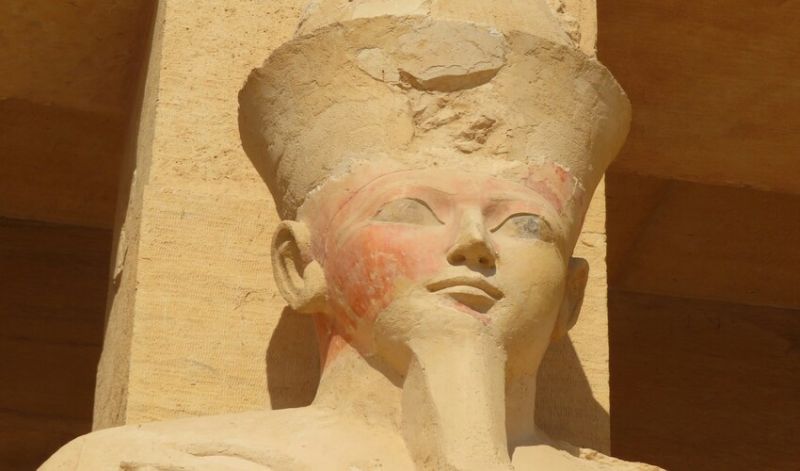
While most ancient Egyptians were used to seeing men on the throne, Hatshepsut’s ambition and smarts set her apart. When her husband Thutmose II (her half-brother) passed away, Egypt faced a big dilemma. The official heir, Thutmose III, was just a toddler. Hatshepsut first acted as regent, but soon she took complete control, claiming the title of pharaoh. She didn’t just rule from the sidelines; she showed up in art and statues with a ceremonial beard and the regalia of kings, making it clear she was Egypt’s true leader.
Egypt’s Golden Years
What did Hatshepsut do with her power? She transformed Egypt. Her reign lasted over two decades and was marked by peace, prosperity, and clever diplomacy. Hatshepsut sent daring trade expeditions to far-off places like the Land of Punt (present-day Somalia), bringing back gold, frankincense, myrrh trees, animals, and hidden treasures. If you can imagine a New York Times feature on ancient luxury imports, her ships would have been headline news.
Rather than chasing endless wars, Hatshepsut made friends with strategic neighbors. She built alliances, boosted the economy, and left her mark with building projects that still inspire awe today.
Lasting Legacy in Stone
The Mortuary Temple of Hatshepsut at Deir el-Bahri looks like something out of a dream. Carved right into the rock face, its grand sweeping terraces blend seamlessly with the cliffs. This masterpiece, designed by her advisor Senenmut, is packed with stories. Its walls feature etched reliefs of her greatest achievements, the magnificent gods she honored, and even the legendary voyage to Punt.
But Hatshepsut didn’t stop there. She commissioned more obelisks than any ruler before. The tallest stands at Karnak Temple in Luxor, a granite spike gleaming in the sunlight. If you stand at its base, you’re touching history she shaped with her ambition.
Myths and Mysteries
For centuries, myths swirled around Hatshepsut. Some say her father intended her for the throne; others whisper about a forbidden romance with Senenmut. No matter what version you believe, one thing is sure: Hatshepsut was a master storyteller. She didn’t just rule Egypt; she rewrote the story of what was possible.
Of course, not everyone cheered for her. After her death, later pharaohs—including Thutmose III and possibly Amenhotep II—tried to erase her memory by chiseling away her images and names from monuments. But history, like the Nile, has a way of resurfacing what was once hidden.
What Became of Hatshepsut
Hatshepsut passed away around 1458 BC, leaving Egypt stronger than she found it. The debate lingers over her cause of death, but modern researchers believe she likely had bone cancer and complications after a dental procedure. Her tomb in the Valley of the Kings is as mysterious as her life, with stories of hidden chambers and lost mummies keeping archaeologists busy.
Today, travelers like you walk the same halls she once did, gaze up at her obelisks, and marvel at her painted reliefs. The grandeur of her temple, the stories carved on its walls, and her bold rule all invite you to discover Egypt not just as a place of ancient wonders, but as a land where visionaries have always reigned.
Why Hatshepsut Still Captivates
Hatshepsut’s life is more than a chapter in a guidebook; it’s a call to adventure for those who crave stories of resilience, vision, and bold cultural leaps. Whether standing under the hot sun in Luxor or planning your Egyptian getaway from your living room, her story sparks the imagination. It reminds every traveler that the most epic journeys are shaped by those who dare to lead.
Related reading: Temple Of Hatshepsut | Luxor City | Thutmose III
When you are ready to book, browse our Luxor day tours.