Was Pharaoh Akhenaten the Rebel King Who Changed Egypt Forever?
Few rulers in world history have sparked as much fascination and debate as Pharaoh Akhenaten, the enigmatic monarch of ancient Egypt’s 18th Dynasty. Born as Amenhotep IV, he ascended the throne around 1353 BCE and swiftly dismantled centuries of religious traditions, political alliances, and artistic conventions. His reign marked an unprecedented era of transformation—an attempt to recast Egypt’s entire ideological foundation. But was Akhenaten truly a revolutionary visionary or a heretical ruler whose radical ideas nearly tore Egypt apart? The story of this so-called 'Rebel King' continues to captivate historians, archaeologists, and travelers exploring Egypt’s timeless wonders on incredible Egypt Travel Packages.
In just under two decades, Akhenaten revolutionized Egypt’s faith, replacing the pantheon of gods with the singular worship of Aten—the radiant sun disk. He built a magnificent new capital city, Akhetaten (modern-day Amarna), and inspired a new artistic style that broke free from rigid conventions. Yet, following his death, the old gods returned, his monuments were defaced, and his memory was nearly erased from history. Still, his legacy endured, influencing art, theology, and even modern perceptions of monotheism. To understand whether Akhenaten truly changed Egypt forever, we must journey through his reign, his beliefs, and the lasting echoes of his rebellion that continue to shape the story of ancient Egypt.
The Rise of Akhenaten: From Prince to Pharaoh
Akhenaten was born Amenhotep IV, the son of Amenhotep III and Queen Tiye, during a period of immense wealth and stability. His upbringing was steeped in luxury, surrounded by opulence and divine symbolism. Yet, from the moment he claimed the throne, Akhenaten’s vision diverged sharply from that of his ancestors. He began by honoring Aten alongside the traditional gods but soon elevated Aten as the supreme deity—effectively positioning himself as the sun’s divine intermediary. This dramatic theological pivot disrupted Egypt’s established priesthood, especially those devoted to Amun, one of the most powerful deities in Thebes. Visitors exploring historical Theban sites today through Luxor Day Tours can still trace remnants of this turbulent shift in religious power.
Akhenaten’s early reign reveals a ruler torn between tradition and innovation. While his father had embraced divine kingship, Akhenaten reinterpreted it in a profoundly personal way. He was not merely Aten’s servant but its living incarnation—a bold declaration that alienated Egypt’s elite yet solidified his ideological authority.
The Birth of Atenism: Egypt’s First Monotheistic Revolution
Akhenaten’s religious reform—known as Atenism—was a seismic shift in Egyptian spirituality. Aten, depicted as a sun disk extending life-giving rays to humanity, replaced the vast pantheon of gods that had defined Egyptian belief for millennia. Temples were built open to the sky, emphasizing Aten’s brilliance and life-sustaining energy. This monotheistic vision was so unprecedented that it redefined Egypt’s spiritual identity. To experience the landscapes once bathed in Aten’s sunlight, travelers often embark on Egypt Nile Cruises, passing the same fertile banks where Akhenaten’s new order flourished briefly but brightly.
However, Akhenaten’s devotion to Aten wasn’t purely theological. It was also a masterstroke of political reform. By undermining the Amun priesthood’s economic and spiritual dominance, he centralized power directly under the royal family—reshaping Egypt’s religious dynamics into a personal empire of divine kingship.
Amarna: The City of the Sun God
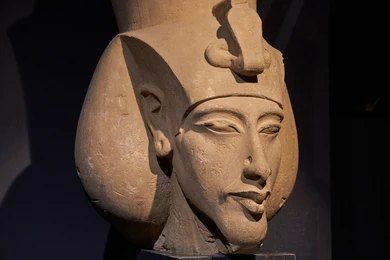
To manifest his divine ideals, Akhenaten founded a new capital—Akhetaten, meaning “Horizon of the Aten.” Situated between Thebes and Memphis, this purpose-built city symbolized a clean break from the past. It was a dazzling metropolis of temples, open courtyards, and palaces, all aligned with the sun’s path. The art of this city reflected a softer, more human portrayal of royalty. Statues depicted Akhenaten with elongated features and tender affection toward his wife, Nefertiti, and their daughters. Today, the remnants of Amarna stand as a haunting testament to the king’s audacious dream, drawing curious explorers on Egypt Adventure Tours eager to uncover its buried secrets.
Nefertiti: The Queen Behind the Revolution
No account of Akhenaten’s reign is complete without mentioning Queen Nefertiti, his co-regent and partner in devotion. Together, they embodied divine perfection, worshiping Aten with an intimacy that blurred the lines between the mortal and the divine. Nefertiti’s image adorned temples and steles, suggesting her influence extended beyond ceremonial roles. Some theories even propose she ruled briefly after Akhenaten’s death under the name Neferneferuaten. Her beauty and power remain etched in Egyptian art, symbolizing the golden yet fragile age of Atenism.
The Backlash: Aftermath of a Failed Utopia
After Akhenaten’s death, his successors swiftly dismantled his reforms. The capital at Amarna was abandoned, Aten’s temples destroyed, and the old gods—especially Amun—restored to prominence. Tutankhaten, Akhenaten’s son, changed his name to Tutankhamun, symbolizing the return to orthodoxy. The restoration era erased Akhenaten’s name from king lists and monuments, branding him a heretic. Yet ironically, this attempt to erase him ensured his mythical status endured. Modern travelers exploring the treasures of Tutankhamun at The Egyptian Museum Of Cairo often trace the line back to Akhenaten’s revolutionary experiment that shaped the young pharaoh’s early life.
Akhenaten’s Artistic Revolution and Legacy
Akhenaten’s reign wasn’t just a religious upheaval—it was an artistic renaissance. Abandoning traditional rigid forms, his artists captured emotion, movement, and realism like never before. Scenes of the royal family playing with their children or worshiping Aten became common motifs, emphasizing warmth and humanity. This artistic transformation mirrored Akhenaten’s vision of a world illuminated by divine light and truth. Many historians view this as the birth of expressive realism in ancient Egyptian art—a legacy that outlived his theological revolution. For those tracing Egypt’s timeless creative journey, Cairo Day Tours offer glimpses into museums and ancient sites bearing these artistic echoes.
Modern Interpretations: Was Akhenaten the First Monotheist?
Scholars still debate whether Akhenaten’s worship of Aten represents the world’s first monotheism or a politically motivated cult. Some see him as a spiritual pioneer who laid the groundwork for later monotheistic faiths; others argue he pursued divine exclusivity to consolidate power. Regardless, Akhenaten challenged the status quo, redefining what it meant to be both king and god. His radical ideas still inspire theologians, Egyptologists, and travelers pondering humanity’s quest for divine unity while cruising Egypt’s sacred waterways on Luxury Nile Cruises.
Akhenaten’s Legacy in Modern Egyptology
The rediscovery of Akhetaten in the 19th century reignited interest in Egypt’s most controversial pharaoh. Excavations revealed letters, reliefs, and artifacts that painted a vivid picture of his reign. Modern Egyptology views Akhenaten not merely as a heretic but as a visionary who dared to question divine tradition. His story has become a central narrative in understanding ancient Egypt’s complexity—an enduring symbol of individuality against conformity. For those captivated by archaeology and history, exploring his legacy enriches any journey through Luxury Egypt Tours.
Conclusion: The Rebel King’s Undying Light
Pharaoh Akhenaten’s reign may have been short-lived, but its impact reverberates through the annals of time. His daring religious revolution, innovative art, and bold reimagining of divine kingship forever reshaped Egypt’s cultural and historical landscape. Though his successors tried to erase his memory, they couldn’t extinguish the radiant light of his vision. Whether viewed as a heretic or a prophet, Akhenaten remains one of history’s most enigmatic figures—a rebel king whose quest for divine truth changed Egypt forever.
FAQs About Pharaoh Akhenaten
Who was Pharaoh Akhenaten?
Pharaoh Akhenaten, originally Amenhotep IV, was an 18th Dynasty ruler who introduced a revolutionary monotheistic religion centered around Aten, the sun disk. His reign marked one of the most radical cultural and religious shifts in Egyptian history.
Why is Akhenaten called the 'Rebel King'?
He earned the title 'Rebel King' because he defied Egypt’s traditional polytheism, abolished the worship of Amun, and established Aten as the sole god. His actions disrupted centuries of religious tradition and political stability.
What was the significance of Amarna?
Amarna, or Akhetaten, was Akhenaten’s capital city built to honor Aten. It was a bold experiment in urban planning and religious symbolism, reflecting the spiritual core of his revolutionary ideology.
What happened after Akhenaten’s death?
After his death, Egypt quickly reverted to traditional beliefs. His successor, Tutankhaten, renamed himself Tutankhamun, restoring the old gods and moving the capital back to Thebes. Akhenaten’s monuments were defaced, and his name was erased from records.
How does Akhenaten influence modern thought?
Akhenaten’s vision of a single, all-powerful deity has sparked debates about the origins of monotheism. His individuality, artistic innovation, and defiance of convention continue to inspire historians, spiritual thinkers, and anyone fascinated by ancient Egypt’s mysteries.