Famous Egyptian Queens: The Women Who Shaped Ancient Egypt
Ancient Egypt is often told as a story of kings, but some of its most remarkable figures were women. A few ruled as pharaoh in their own right, others governed for young sons, and several royal wives held real political influence. Their temples, tombs and portraits are still among the highlights of a trip to Egypt today. Here are the queens every traveler should know, and where you can follow their stories on the ground.
Sobekneferu: The First Confirmed Female Pharaoh
At the end of the 12th Dynasty, Sobekneferu ruled Egypt as king for only a few years, around 1806 to 1802 BC. She is the first woman for whom there is firm archaeological evidence of a reign as pharaoh in her own right, and unlike some later female rulers she was shown in a mix of royal and feminine dress.
Ahmose-Nefertari: Founding Queen of the New Kingdom
Ahmose-Nefertari was the wife of Ahmose I, who founded the 18th Dynasty, and she acted as regent for her son Amenhotep I. Long after her death she was honored as a protective figure on the west bank of Thebes, the area of modern Luxor.
Hatshepsut: The Woman Who Became King
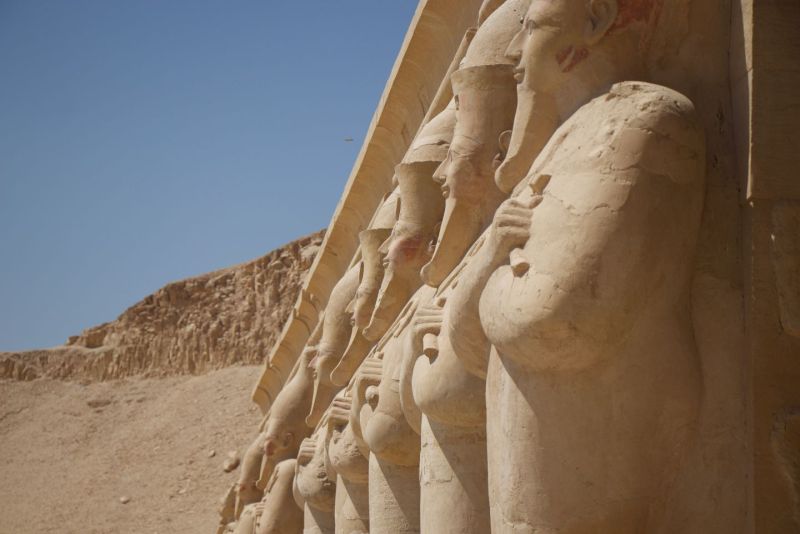
Hatshepsut, daughter of Thutmose I, first governed as regent for the young Thutmose III and then took the throne herself, becoming the longest-reigning female pharaoh of a native Egyptian dynasty. Many of her statues show her with the traditional regalia of a male king. Her terraced mortuary temple at Deir el-Bahari is one of the most striking monuments in Egypt; read our guide to the Temple of Hatshepsut and the full story in our article on Hatshepsut.
Tiye: A Queen at the Center of Power
Tiye was the principal wife of Amenhotep III and the mother of Akhenaten. Ancient records show her involved in state and foreign affairs, and she remained an important figure into her son’s reign.
Nefertiti: The Face of the Amarna Age
Nefertiti was the wife of Akhenaten and played a prominent role in the worship of the sun disk, the Aten. Her painted portrait bust, now in Berlin, is one of the most famous sculptures from the ancient world. Some scholars believe she may have ruled after Akhenaten under another name, although this is still debated. Learn more about her husband in our article on Akhenaten, the rebel king.
Nefertari: Beloved Wife of Ramses II
Nefertari was the most celebrated wife of Ramses II. The king dedicated the Small Temple at Abu Simbel to her and to the goddess Hathor, and her beautifully painted burial chamber in the Valley of the Queens is often called the finest tomb in Egypt. See our guides to the Tomb of Nefertari and the Valley of the Queens. Her daughter later became a queen too; read Who Was Queen Meritamen?.
Cleopatra VII: The Last Queen of Ancient Egypt
Cleopatra VII ruled from 51 to 30 BC and was the last monarch of the Ptolemaic dynasty, a royal family of Macedonian Greek origin. Her alliances with Julius Caesar and Mark Antony made her one of the most famous women in history. Her capital was Alexandria, where much of the ancient royal quarter now lies beneath the sea.
Where to Follow the Queens in Egypt
- Luxor: The Temple of Hatshepsut, the Valley of the Queens and the temples of the west bank are easy to combine on Luxor day tours.
- Abu Simbel: The Small Temple of Nefertari and Hathor stands beside the Great Temple of Ramses II.
- Cairo: Royal statues and objects from these periods are displayed in Egypt’s great museums, including the Egyptian Museum of Cairo.
- Alexandria: The city of Cleopatra, with its Greco-Roman sites and Mediterranean waterfront.
Interested in the role of women in Egypt today? Read our article on women's rights in Egypt.